Contact: mriley@earglasses.com Big Ideas Incorporated, 6425 North 75th Drive, Glendale, AZ 85303
To review our Privacy Policy, click here.
Copyright © 2022 by Big Ideas Incorporated
THE SCIENCE
A Simple Shape Based on Sound Science
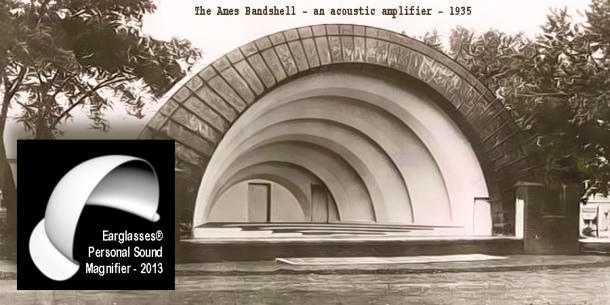
Each Earglasses® sound reflector is formed from a parabolic arc rotated 180° into an acoustic lens. The shape performs like a miniature concert bandshell. The arc has a focal point at the center of your outer ear, to concentrate sounds coming from in front of you. The intensified sound bounced into your ear canal retains a coherent wave form, and the proper, upright auditory image of the sound's source. The device has been awarded two U.S. Utility Patents, numbers 4,997,056 and 8,122,995.
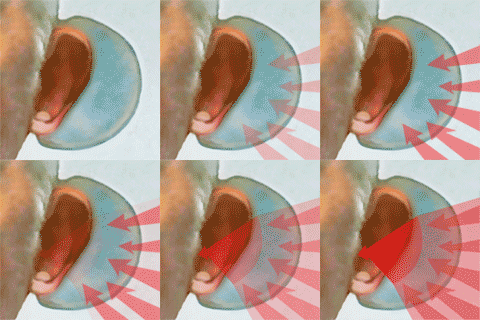
Sound waves bounce off of Earglasses® lens’
inner face, into the user's ear canal.
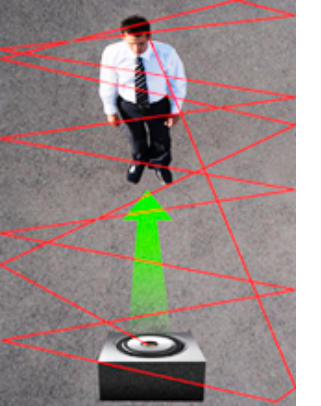
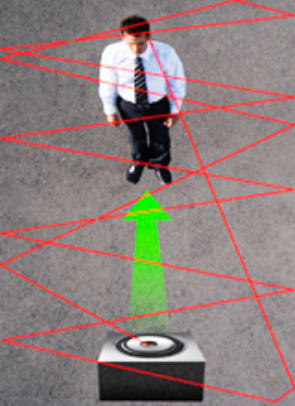
On-axis good sounds (green arrow) versus
the anti-Haas-effect evil sounds (red) echoes.
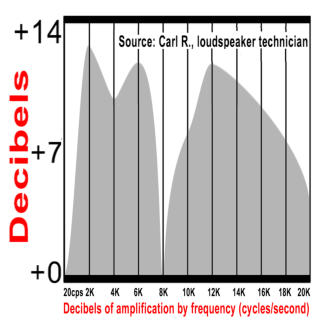
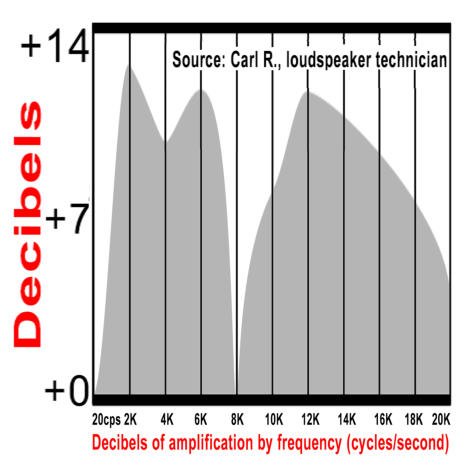
The chart shows the frequencies boosted by
Earglasses® new model’s lenses. These results
from a sound technician’s measures show
that our new model amplifies even better
than our old headband-mounted lenses did.
The increased volume of sound at frequencies
above 8,000 cycles per second are of great
importance, since that’s where people tend
to lose their hearing first. And this is the
region where our new model shows the
greatest improvement over our old model.
The lenses are precision molded from a high impact, non-reverberant, clear
plastic. The shells reflect fully 94% of the sound energy that strikes them.
They also reject noise which comes from your sides and your back. This
deceptively simple device has some sound science behind it:
1. Improved Haas Precedence Effect - the direct sound from a source like a
TV loudspeaker tends to mask the distracting noise of room "echoes" that
have been reflected and delayed by up to 30 milliseconds.This is a sonic
benefit called the Haas Precedence Effect. But sounds that travel over 35
feet, reflecting off of walls, floors, ceilings and back again, can overcome the
Haas effect. This can blunt your ability to understand words, and can blur
sounds from audio systems or live musicians. Earglasses® lenses can block
out over 55% of those sound-image-destroying room reflections.
2. Less Off-Axis Response – almost all loudspeakers' most accurate
frequency response comes straight out from their fronts. Unfortunately, a
loudspeaker's "off-axis" sounds make up most of a listening room's
reflections. These sounds are more highly distorted as well as less
dynamically accurate. Here again, by reducing the ears' acceptance of
reflected sound, Earglasses® lenses can make any decent loudspeaker with
good on-axis response sound much more accurate. Even a boombox can
begin to have some of the listening quality of a high-end audio system.
3. Non-electronic Amplification - our reflectors amplify mid-to-high-
frequency sounds by over twelve decibels. Though lower in amplitude than
the gain produced by electronic hearing aids or personal sound amplifiers,
this amplification can be more useful in several respects. The lenses'
amplification frequency curve complements the frequencies most often lost
due to age-induced hearing declines. Also, the gain is perfectly phase-
coherent, and noise free. The lenses of course can't be damaged by
perspiration, and never need batteries or electronic repairs. The sounds
which are most powerfully amplified are those which carry sounds' details,
and the most delicate, easily muffled overtones.
4. Out-Of-Home Use - their appearance aside, Earglasses® lenses are well
suited to use in venues where delicate sounds die quickly. At "packed house"
musical performances, in the thinner air of mountain altitudes, or in sound-
damping humid weather, musical instruments' overtones can lose over 25
decibels in volume just moving from the front to the rear of a concert hall.
Users at lectures, plays, operas and concerts will immediately notice the
reduced distractions of audience noise, and the way performers' or
lecturers' intelligibility is enhanced, even from seats in the very back row.
5. Ergonomics - the shape of the Earglasses® lens has been carefully
determined by merging human factors and acoustic data. For example, the
lens' size is based on medical census data regarding the typical size of the
human ear, and the position of the ear canal opening in relation to the rear
of the typical pinna. And the curve of the lens is designed to preserve phase
coherency of sound waves as they bounce off of the lens and the concha,
and are sent into the opening of the ear canal.
6. Research and Development - we learned a great deal from testing our
first model's shape in a sound laboratory's anechoic chamber. These
findings plus empirical testing of prototypes produced by "3D Printing"
aided design of our new model. Without the application of the findings from
these experiments, the product's performance and comfortability would
have been significantly reduced.


THE SCIENCE
A Simple Shape Based on Sound Science
Each Earglasses® sound reflector is formed from a parabolic arc rotated 180° into an acoustic lens. The shape performs like a miniature concert bandshell. The arc has a focal point at the center of your outer ear, to concentrate sounds coming from in front of you. The intensified sound bounced into your ear canal retains a coherent wave form, and the proper, upright auditory image of the sound's source. The device has been awarded two U.S. Utility Patents, numbers 4,997,056 and 8,122,995.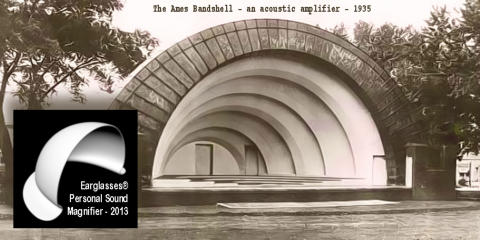

Contact: mriley@earglasses.com Big Ideas Inc., 6425 North 75th Drive, Glendale, AZ 85303
To review our Privacy Policy, click here.
The lenses are precision molded from a high impact, non-
reverberant, clear plastic. The shells reflect fully 94% of the
sound energy that strikes them. They also reject noise which
comes from your sides and your back. This deceptively
simple device has some sound science behind it:
1. Improved Haas Precedence Effect - the direct sound
from a source like a TV loudspeaker tends to mask the
distracting noise of room "echoes" that have been reflected
and delayed by up to 30 milliseconds.This is a sonic benefit
called the Haas Precedence Effect. But sounds that travel
over 35 feet, reflecting off of walls, floors, ceilings and back
again, can overcome the Haas effect. This can blunt your
ability to understand words, and can blur sounds from
audio systems or live musicians. Earglasses® lenses can
block out over 55% of those sound-image-destroying
room reflections.
2. Less Off-Axis Response – almost all loudspeakers' most
accurate frequency response comes straight out from their
fronts. Unfortunately, a loudspeaker's "off-axis" sounds
make up most of a listening room's reflections. These sounds
are more highly distorted as well as less dynamically
accurate. Here again, by reducing the ears' acceptance of
reflected sound, Earglasses® lenses can make any decent
loudspeaker with good on-axis response sound much more
accurate. Even a boombox can begin to have some of the
listening quality of a high-end audio system.
3. Non-electronic Amplification - our reflectors amplify
mid-to-high-frequency sounds by over twelve decibels.
Though lower in amplitude than the gain produced by
electronic hearing aids or personal sound amplifiers, this
amplification can be more useful in several respects. The
lenses' amplification frequency curve complements the
frequencies most often lost due to age-induced hearing
declines. Also, the gain is perfectly phase-coherent, and
noise free. The lenses of course can't be damaged by
perspiration, and never need batteries or electronic repairs.
The sounds which are most powerfully amplified are those
which carry sounds' details, and the most delicate, easily
muffled overtones.
The chart shows the frequencies boosted by Earglasses®
new model’s lenses. These results from a sound technician’s
measures show that our new model amplifies even better
than our old headband-mounted lenses did.
The increased volume of sound at frequencies above 8,000
cycles per second are of great importance, since that’s where
people tend to lose their hearing first. And this is the region
where our new model shows the greatest improvement
over our old model.
4. Out-Of-Home Use - their appearance aside, Earglasses®
lenses are well suited to use in venues where delicate sounds
die quickly. At "packed house" musical performances, in the
thinner air of mountain altitudes, or in sound-damping humid
weather, musical instruments' overtones can lose over 25
decibels in volume just moving from the front to the rear of a
concert hall. Users at lectures, plays, operas and concerts will
immediately notice the reduced distractions of audience
noise, and the way performers' or lecturers' intelligibility is
enhanced, even from seats in the very back row.
5. Ergonomics - the shape of the Earglasses® lens has been
carefully determined by merging human factors and acoustic
data. For example, the lens' size is based on medical census
data regarding the typical size of the human ear, and the
position of the ear canal opening in relation to the rear of
the typical pinna. And the curve of the lens is designed to
preserve phase coherency of sound waves as they bounce
off of the lens and the concha, and are sent into the opening
of the ear canal.
6. Research and Development - we learned a great deal from
testing our first model's shape in a sound laboratory's anechoic
chamber. These findings plus empirical testing of prototypes
produced by "3D Printing" aided design of our new model.
Without the application of the findings from these
experiments, the product's performance and comfortability
would have been significantly reduced.
Copyright © 2016 by Big Ideas Incorporated